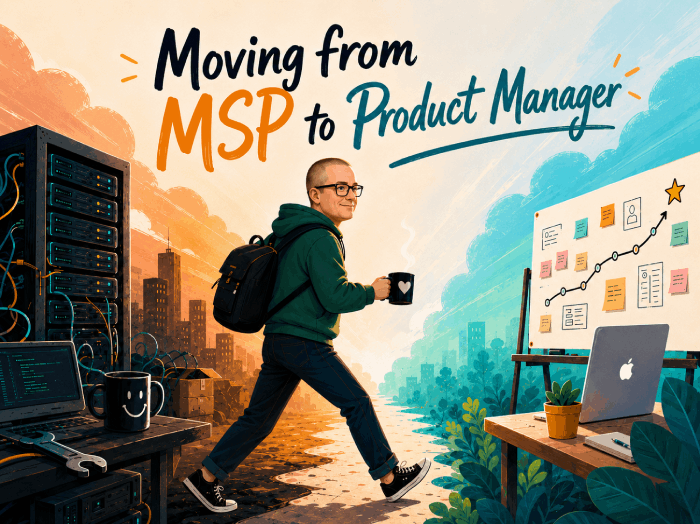
Hello fellow humans! I wanted to talk to you all about something a bit more personal today. It’s been four years now since I moved from MSP to Product Manager. It was one of the biggest professional shifts I’ve ever made, and I’ve learned a huge amount (some of it the hard way). So grab a cup of tea (not Liptons) and let me walk you through that journey.
For those of you who don’t know the backstory, I spent years deep in the MSP world (15 years) that saw me go from First Line Support through eventually to CTO. Along the way I also did consulting for many MSPs and also got to help fellow MSPs in the MSPGeek community.
In 2022 I did something that, on paper, looked a little bit mad - I left MSP land and joined NinjaOne as Product Manager. It took me a long time to weigh up the pros and cons, greatly guided by my friend and colleague Stephen Murphy who had gone to “the dark side” a number of months earlier. My initial goal was to be part of a company and product that would allow me to build the RMM of my dreams.
The thing I expected to struggle with - and didn’t
I assumed my biggest weakness would be my lack of Product Management skills. Up until that point, I hadn’t had much exposure in that realm. Once I knew I was coming into the job, I had two months where I read as much as I could and learned as much as I could about becoming a Product Manager.
I remember on my first official day working at Ninja looking at my almost empty calendar and thinking “Wow, so much room for activities!” and wondering “What do I do now?” I was fortunate to have the initial excellent guidance and mentorship of Rahul Hirani, AJ Singh and Leo Hernandez. Three extraordinary people who I was lucky to get guidance from early in my journey. Rahul in particular spent a long time walking me through the core fundamentals of Product Management. He may not believe it if you told him, but Rahul is a natural born teacher and leader. It’s only in retrospect that I realise how lucky I was to have a lot of my core PM fundamentals shaped by him. As we brought additional Product Managers in from the MSP space, I did my best to pass down those teachings to our (now ever growing) Product Managers coming into Ninja.
As I learned more, I found a lot of my existing skills translated well to Product Management skills. A relative intuition for good UI and UX, a deep understanding of the problem space, a deep understanding of technical operations and an ability to lead through influence and buy-in rather than from authority. I thought I’d struggle here, but these things seemed well suited to my existing skills so they came quickly and naturally.
The thing I expected to struggle with, and actually did
It took me, I would say, a good 6 months to understand the operational complexity and structure of Ninja. So many new concepts I had not considered. So many teams doing different things. So many new acronyms. Even now on a monthly basis I am learning so much. The thing I would struggle with the most though came from our CEO Sal.
Sal is truly an exceptional human being. I’m not just saying that because he’s my boss and ultimately keeps me employed, I’m saying it because he’s the antithesis of a typical tech CEO and his challenge to me ultimately shifted my entire view on how NinjaOne could work as a tool. He’s kind, patient, accessible, highly technical and most importantly has a unique ability to link threads and think across hundreds of different areas at once allowing him to be extremely forward thinking and to spot gaps that no-one else can see. He spotted almost immediately the gap I needed to fill - understanding of non-MSP environments.
Having deep experience in one particular market segment as a Product Manager is almost a cheat code. As I (and Ninja) built things, I inherently understood how these features would land with and be received by MSPs as well as where the gaps were. Of course though, Ninja caters to the Internal IT and Enterprise world as much as it does MSPs. Getting guidance and alignment from Sal in identifying this gap early on this journey allowed me to adapt how I approached building features. I’d go out of my way to consider non-MSP points of view and ensure to put what I was building under a lens that represented as many market segments as possible. Once it fully clicked it made me a much better Product Manager, but it was not easy.
The other big lesson: learning the weight of saying “no”
As someone from a technical, jump in and ‘get it done’ background my instinct was always to build. See a problem, think about it, decide it’s a good idea then build it FAST. That approach is a superpower at an MSP. As a PM, it can be a liability.
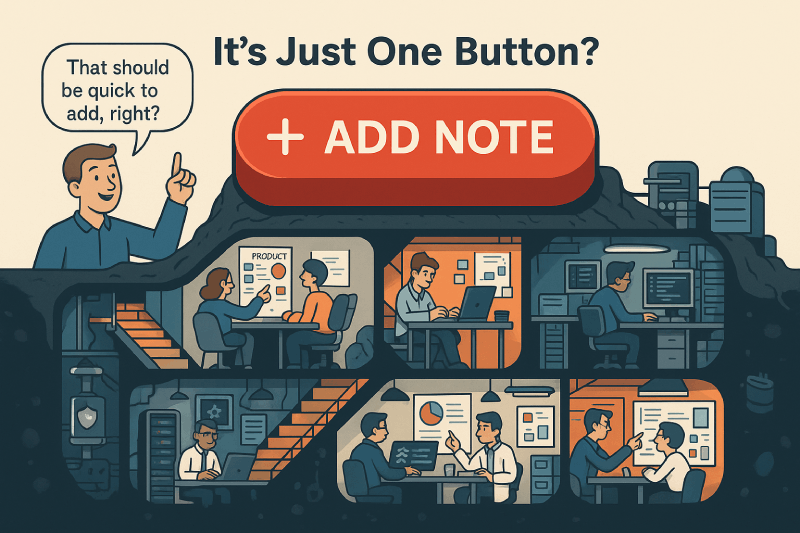
The real job a PM does is understanding the problem so deeply that the solution almost designs itself, and then saying no to about ninety-five percent of everything else. I wrote about the true lifecycle of a feature request before but learning to say no was, and honestly still is, the hardest skill for me. As a technical person you can see that almost anything is possible. For most of our feature requests I can mentally map how we could build and achieve them. The actual PM job is deciding what is actually worth it and worth it for which of our very different audiences. Every time you say yes, you are making a HUGE strategic bet that the choice is the most important thing that team can do at that time to have the biggest positive impact on NinjaOne and its customers. This is a much more nuanced and difficult decision than I think most people realise.
The bit that surprised me
My biggest surprise is how much of the job is emotional and human, not technical. I expected roadmaps and Jira, and yes, there’s plenty of that but the real work is in the trust and relationship building. Building that with engineers, designers, with leadership and with partners allows the PM role to be much better executed. Being curious and not judgemental in this space will take you far. Being willing to help stitch multiple teams together and offer a helping hand to move projects through their lifecycle is another superpower.
I also underestimated how much I’d miss being “in it.” There’s a specific dopamine hit from fixing a broken process with a script or fixing a broken server with your own hands that a PM doesn’t get in the same way. My wins are slow now; more diffuse and shared across a big team. That said, when something I helped shape goes into the product and one of our customers tells me it made their day genuinely easier - that hits different. When you see your feature being used by tens of thousands of customers, it’s magical. It’s a slower burn, but it scales in a way that helping one MSP at a time never could.
Final thoughts
Would I do it again? In a heartbeat. Four years in, I still think about that almost empty calendar on day one (it’s definitely not empty now!!), wondering what on earth I’d do with myself. I know now the answer was to learn to say no, to learn to sit with not building things myself, and to learn that the biggest lever I have isn’t a keyboard - it’s the trust of the people around me. That’s not the trade I expected to make when I left my old MSP, but it’s the one that ended up being worth it. This move to Ninja has been one of the most challenging but rewarding things I’ve done professionally. It stretched muscles I didn’t know I had and showed me an entire world that had been sitting right next to mine the whole time.

Start the conversation