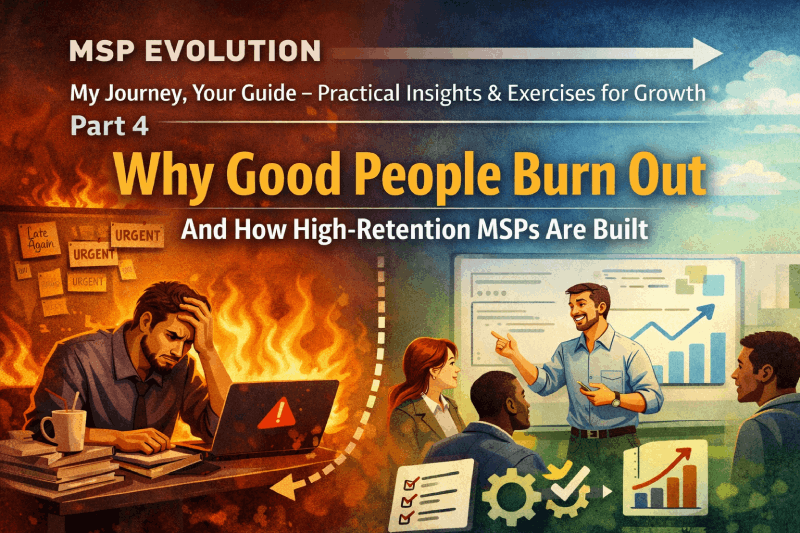

In our last post, we talked about finding new superstars and attracting them to your business. Hiring though is going to feel like the easy part because the real challenge (and the real cost) begins after they arrive. Retention is one of those areas where MSPs either grow or stagnate and fail while slowly bleeding knowledge and culture. Now you have the staff, how do ensure they grow and how do you retain them?
The Retention Problem
The churning of good staff can be one of the most costly and culturally devastating things that can happen to your business. It takes a LONG time to get new people in your business up to speed. In my previous MSP, on average, it used to take 3-6 months of training, mentoring and effort before a new staff member’s presence in the business started to pay off in terms of them able to remove tangible day to day workload. Once they are up to speed, it’s very easy to have high performers become critical parts not just the ongoing operations of your business, but also to its cultural center and its embedded knowledge. When that relationship is not cultivated and treated with the respect it deserves, you get stuck in a loop. Does this sound familiar to anyone?
- One of your senior engineers or high performers leaves
- Knowledge walks out the door with them (but they were the only person who could do that super complicated task!)
- The rest of the team absorbs the workload
- Stress increases
- Another person leaves
- Hiring occurs again, under pressure
Suddenly you’re stuck in this failure loop where you can be bleeding time, money and the patience of your existing staff. Why does this happen, and how can you prevent it?
An Unpopular Truth
Most MSPs don’t lose good people because of money, they lose them because the system around those people slowly grinds and wears them down
This is not a problem that you can easily throw money at and make it go away because the problem goes beyond money, it goes into the core fundamentals of how humans think, feel and want to be treated at their core.
If people are burning out, the system is broken. That system is owned by leadership. The person responsible may even be you.
There are plenty of warning signs that this can be happening already in your MSP - the first is the biggest and going to be the primary topic of this post.
Burnout is treated as normal
There can be such a toxic attitude towards this in the MSP space. I’ve seen some MSPs not treat burnout as the warning sign that is it, but proof they are doing a good job. What do I mean by that?
- Proud of consistently working unsustainable hours for “the business”
- Framing things like frequently having to stay late as “hard work”
- Keeping one person on-call because they are your “superstar employee who can deal with everything”
- Making poor decisions or selling technically unfeasible solutions that promise the world because “they always can pull some magic to get it implemented”
- Giving an already overrun person more things to do because they are “really good at multi-tasking”
All of these things are not something to be proud of, they are signs that an MSP is pushing its staff to burnout. This is normalized in so many MSPs, and I am here to tell you it’s not meant to be normal because the people who burnout first are usually your best people.
The Silent Agreement
In the MSP space, to me at least, there seems to be an unspoken contract in many MSPs. “This is just the way that it is, if you can’t handle it, maybe MSP life isn’t for you”. When this culture is pervasive people stop complaining, they stop giving feedback, they stop asking for help. They just endure. Until they don’t.
Why Burnout Hits MSPs So Hard
To understand how to prevent it, we have to understand why burnout is so prevalent in the MSP space. In many ways, MSPs have the conditions to create a perfect storm for burnout:
- High volume of tickets that never end - there’s always another alert
- Constant interruption - staff can’t get room to think because every 5 minutes something else arrives and is put on their plate
- Emotional toll - staff absorb constant customer frustration, panic and stress. This especially impacts those who are actually and genuinely empathetic to your clients
- Security threats that are difficult to manage that cause stress and worry
- Hero culture - staff who save the day get praised, and then rewarded with more work.
Burnout for MSP staff is not a failure of resilience, it’s a predictable outcome of a broken system.
The Warning Signs To Look Out For
These should scream “red flag” to you if these are going on in your business - to me they signify an MSP who is likely burning out their staff.
- Staff work late without even being asked
- Vacations/holidays aren’t really holidays, staff stay plugged into company comms and answer questions
- Internally there is irritability, cynicism and disengagement
- Fewer ideas, less curiosity and more shortcuts taken
- High performers going quiet
So What Can I Do To Prevent This?
A high retention MSP builds systems that make burnout difficult and not inevitable and there are several ways that you can do this
You design for sustainable throughput not maximum utilisation
This means keeping a close eye on the amount of work that is coming into the business and the current effort required to support clients to an appropriate standard. It means delaying or saying no to projects that will push your staff over the edge. It means planning for 70-80% utilisation because a system at 100% utilisation collapses the moment anything unexpected happens and hey this is MSP; unexpected things always happen!
You cap the amount of work in progress
Instead of a mantra of just grabbing the next available ticket, enforce things like a maximum amount of tickets per engineer. Measure your tickets across staff working on a like for like basis. Is one person clearing 50 tickets a day but another person 10? Why? Always root cause things like this because you’re guaranteed to find something interesting.
You protect deep work and focus time
Treat focus as sacred and ensure those that need it have the time they need to appropriately think and work through a problem without being interrupted. Start by having clear rules for what is truly urgent, that way there can be a good balance between being ‘disturbed’ while focussing and also ensuring the needs of the business are met.
You measure load, not just output
What does this mean? Examples of measuring output would be the number of tickets closed, the SLA hits, or say utilisation of a particular engineer or person. Measuring load looks at things like the average number of active tickets, time spent in context switching, how much time is spent in after-hours work, looking at the cognitive load per role.
You remove hero culture (even when it hurts you to do so)
So frequently things like staying late, saving broken processes, carrying other peoples load or being the “only one who knows” are rewarded and treated as a positive thing. Winning here in my mind means shifting what you actually reward. Reward good documentation. Reward automation and good delegation. Reward those who teach others and don’t hold on to institutional knowledge. Fix problems that have a clear root cause which have caused your staff stress. Make sure staff get vacation (and are not bothered while they are on it)
A little side note on hero culture. There are actually some people who thrive on being the saviour. Is there anyone in your MSP who derives their identity and gets validation from being the rescuer or fixer? This is actually called Hero Syndrome and in MSP it can look like having people who hoard knowledge or they volunteer for every escalation. Sometimes these people will even undermine systems so they remain indispensable. These people can often be your best staff members or your fastest fixers. They often don’t mean harm but they anchor the MSP to chaos. You get through to this type of personality by rewarding making themselves unnecessary.
If someone only feels valuable when everything is on fire, they will unconsciously keep lighting matches
You actively invest in your staff’s career trajectory
Give them actual breathing room to learn - this should be scheduled and encouraged with time set aside and accounted for. Mentoring should be recognised as a positive and as a piece of work being performed. Junior engineers should not be left to sink or swim. Ensure they are adequately supported and not just thrown in the deep end.
Reflection Exercise
- Write down the name of the last three people who left your business.
- What were they carrying alone? What did they spend their time doing and what were they best at? (these are areas of investigation to determine if they are causing burnout)
- What system failed them? Did you give an exit interview?
- What are you still relying on heroes to hold together today?



)
Start the conversation