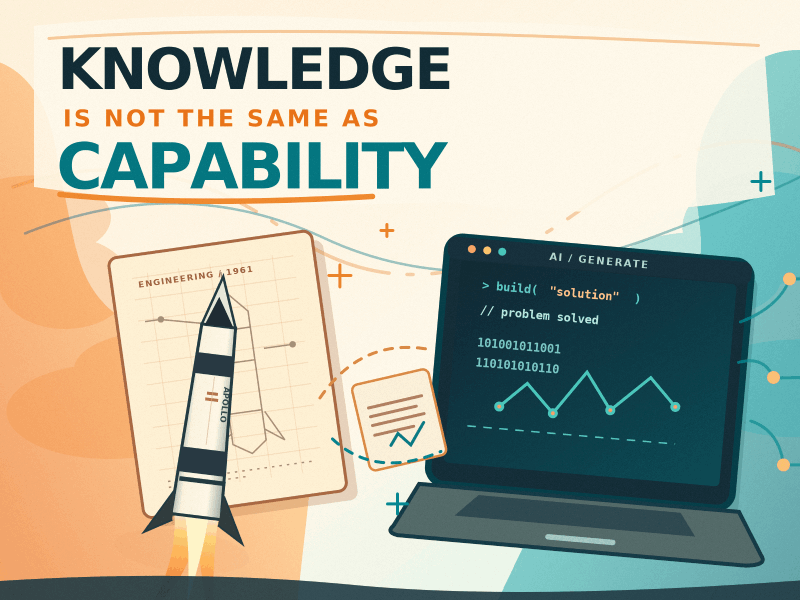

This story does have a point - I promise, and for many of you it will hit close to home. For now please indulge my love of Apollo. Imagine it’s 1961. President John F. Kennedy has just given his famous speech:
I believe that this nation should commit itself to achieving the goal, before this decade is out, of landing a man on the moon and returning him safely to the earth.
– President John F. Kennedy, 25 May 1961, addressing a joint session of the US Congress.
Now consider this – NASA Administrator James E. Webb walks into his office the next morning, and on his desk are detailed plans and blueprints for the Saturn V, Apollo Command Module, Lunar Module, and all the blueprints for the machines, materials and production processes to build Apollo 11. All neatly tied up and wrapped in a bow. Let’s assume they can actually build it, and they do. What’s the impact?
Kennedy’s ambition to get to the Moon is achieved early, bypassing 8+ years of research and development. Sounds good initially, right? I don’t think so, and here’s why:
NASA spent years tackling destructive combustion instability in its F-1 engine. Engineers experimented with different approaches and ultimately developed a reliable solution. In our scenario, the finished engine already contains the solution. The engine works, but much of the knowledge gained from investigating combustion instability does not exist, and there is much less incentive to investigate a problem already solved.
The Apollo Guidance Computer works, but inventing it was skipped. Building it required engineers to solve unprecedented problems in computing power, reliability, memory and real-time software. Those efforts helped advance software engineering through things like fault tolerance, asynchronous processing, priority scheduling and rigorous software testing.
Thousands of engineering challenges simply never exist. The real Apollo programme forced engineers to solve problems involving propulsion, thermal protection, navigation, electronics, life support and the reliability of all these things in space. Research into one problem frequently informed other areas of engineering. Bypassing the original problem means losing discoveries useful in entirely different contexts.
Engineers become experts at building Apollo 11 rather than experts at inventing Apollo 11. They still gain valuable experience, but reproducing an existing solution is a different intellectual exercise from developing a solution that doesn’t exist.
Rejected and failed ideas disappear from the record. These failures and approaches helped establish the boundaries of what was technically possible, which then helped inform other areas.
Apollo brought together universities, contractors, researchers and government institutions to work on extraordinarily difficult problems all working together to invent the seemingly impossible. It built relationships and ways of working together that were more about the journey than the destination.
What happens when we then want to build another spacecraft, like the Space Shuttle? Much of the expertise that was learned during Apollo would not be present, and we’d struggle a lot more to apply those concepts.
When something goes wrong on a later mission, like Apollo 13, does the crew survive? When the O2 tank exploded, Mission Control had to devise entirely new procedures for powering up the Command Module after an extended shutdown. They did this in 3 days, and they could do it that quickly because they had accumulated understanding and experience. One of the reasons Apollo 13 was a “successful failure” was the deep understanding of the engineering, equipment, processes and procedures of Mission Control and the astronauts. When that experience is not there, they become less resilient than they would otherwise have been.
In this world, everyone might believe we had progressed faster. Humans reach the Moon years earlier, and the achievement is celebrated. But decades later, we discover that other fields of tech may have advanced more slowly because the research challenges that helped stimulate them were bypassed. The original Apollo engineers didn’t just discover answers – they discovered previously unknown problems.
So why did I make you read all thise points on a fictional Apollo programme? Because I think we are living, right now, through our own Apollo blueprint moment, but instead of receiving plans for a spacecraft, we’re receiving working software, mathematical proofs, scientific research and completed solutions to problems that previously required years of specialist knowledge.
I genuinely believe that software development isn’t just the act of writing code – it’s a process of discovery. The bugs and challenges you encounter while learning are often where the actual learning happens. Understanding why a database query is inefficient, why two processes conflict or even why an architecture fails under load builds mental models that can be applied to entirely different problems.
This doesn’t even talk about the gap that will be generated in the development of people. If junior developers increasingly delegate those tasks to AI, where does that experience come from? Where do the next senior engineers come from? Will they develop different but equally valuable skills, or will we create a gap in fundamental engineering expertise? What happens when a vibe-coded application encounters a problem that your AI cannot resolve? Do you have people who understand the architecture, can reason about its behaviour and devise an entirely new solution, or have you become dependent on the same system that built it in the first place?
There are certainly counterarguments – eliminating unnecessary work is exactly what technological progress is supposed to achieve, and the time saved could create entirely new opportunities for discovery. AI will definitely help improve our understanding in certain areas. To me, the real risk isn’t that AI makes things too easy; it’s that we could stop recognising which difficult problems were actually WORTH the difficulty in solving them. An AI that can design an extraordinary system genuinely increases what humanity can accomplish, but that doesn’t mean the humans using it have acquired comparable understanding.
A year after his original challenge, Kennedy gave another speech that had one of my favourite ever quotes in it:
“We choose to go to the Moon in this decade and do the other things, not because they are easy, but because they are hard.”
Are we eliminating unnecessary work, or are we eliminating the very experiences that make us capable of solving problems we’ve never encountered before? When humanities own Apollo 13 happens, will we know how to fix the spacecraft and get home? I hope so.


Start the conversation